Yes, this is a blog post about generative, LLM-based ‘artificial intelligence’ (which is a misnomer, since it’s in no way intelligence, so I won’t use the term after this). No, this is not about the technical details, the economic bubble (which it absolutely is) or the insanity of the ‘it’s just a tool’ crowd (no, it’s not, it’s mostly market and regulatory capturing, colonial, predatory surveillance capitalism at it’s worst).
No! This is a blog post about why I personally try to use as little AI as I can (after using it quite intensively). And why I think it’s important to do so.
P.S., a great article on the depravity of the current LLM/agentic boom and bubble can be read here: https://blog.johanneslink.net/2025/11/04/to-gen-or-not-to-gen/. It’s an excellent, well-sourced overview of the technologies’ benefits, its many downsides, and how you can avoid using it, if at all possible.
Why I used LLMs for a while
As I have written many times on this blog, I love Emacs. After I guess two years of daily NeoVim use, I found myself tweaking too much and writing and coding too little. For me, it turned out the integrated workspace I wanted was in NeoVim always just out of reach, which led to me frustratingly trying out all sorts of plugins, other people’s config, fixing Mason errors and incorrect Lua syntax deep into the night.
Finally, I broke, and tried out the infamous Vim/NeoVim ‘competitor’ Emacs. And I fell in love: the really verbose and easy-to-use commands and documentation, the way that it’s a text editor, organizer, shell, all in one, the way many plugins and settings just work. Take, for example, my current Markdown writing environment.
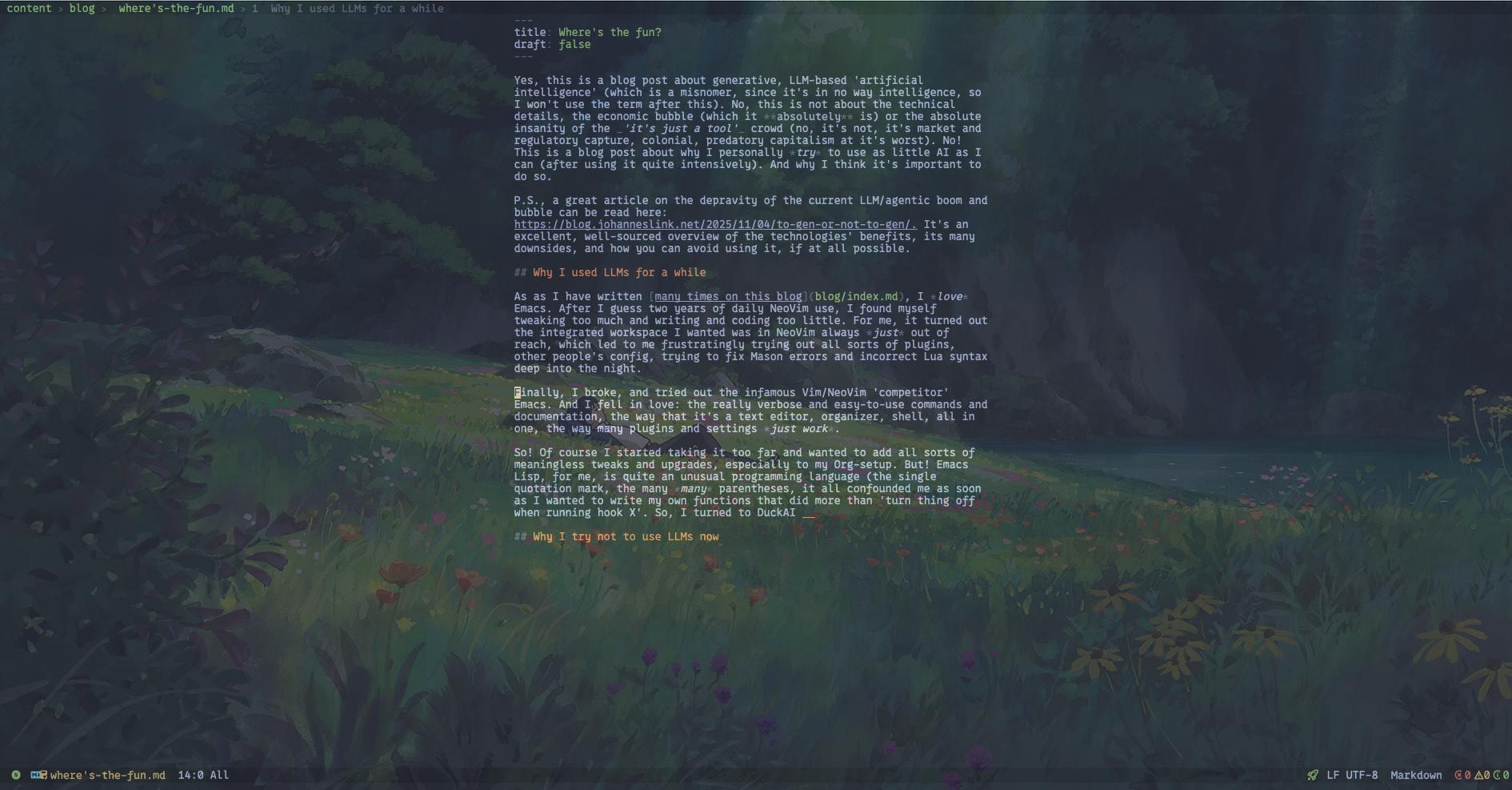
So, of course I started taking it too far and wanted to add all sorts of meaningless tweaks and upgrades, especially to my Org-setup. But! Emacs Lisp, for me, is quite an unusual programming language. The single quotation mark, the many many parentheses, it all confounded me as soon as I wanted to write my own functions that did more than ‘turn thing off when running hook X’. So, I turned to DuckAI and asked it to write me all sorts of functions, hooks, plugin settings, and for a while, it worked great.
Also, in my work as an SOCC-analyst turned information security officer with the Vrije Universiteit, I have to look up a lot of documentation and frequently need a sanity check: does this feature exist? Is it documented somewhere, that this desired use case or defensive measure, is possible? The LLM-powered summaries by various search engines (mostly DuckDuckGo) would sometimes give me a useful answer, and of course, sometimes entirely hallucinate a technical setup which was impossible, or what was way more frustrating, almost get something right: most of the key words were there, but the sentences gave you nothing you could actually use.
As I’ve stated multiple times on this site, I am very very slowly working my way through the ‘Malware development course’ offered by Maldev Academy. I take notes on the course material and especially for the course objectives it has been alluring to let some LLM generate the basic code examples needed.
Finally, I tried to run some small models on my current 2019 Macbook using Ollama, which used up all the available memory even generating an answer. It probably has to do with the laptop’s specifications (it’s a 2,3 GHz 8-Core Intel Core i9 with an Intel UHD Graphics 630 and AMD Radeon Pro 5500M graphics card. I also tried out the Emacs ellama-package for a very short time.
Why I try not to use LLMs now
So, from the start of this article it’s no secret that I deeply distrust the current LLM capitalization: the way online data is stolen for training @purposes, the entirely extractive construction of unnecessary datacenters, the economic disaster of burning money for overpromising LLM/agentic capabilities, the horrible, colonial offloading of data labeling to unprotected, sometimes underage gig workers in the global South. Basically, it’s nothing new. It is surveillance capitalism all over again, only now on a scale and with an financial asset and cost bubble growing big enough that it could hurt all of us (inflation, recession, bailouts, you name it).
So, the ethical, ecological and social concerns for me are quite clear. But also, outside of the impact these technologies have on the world, what is their impact on you, the person using them? Does it make you better, smarter, more capable, confident in your knowledge and skills? The short answer for me, is a resounding NO. Why? Well, let’s sum it up:
-
When the LLM or agent is wrong or hallucinating something unuseful, the time spent writing the prompt, waiting for the thing to spit something out, reading the pedantic, falsely optimistic babble, it’s wasted. What’s more, it’s wasted not with you actually doing something, but mostly waiting. Essentially, it’s a slow, sometimes defective magic eight ball. A brave new world!
-
Some of the commentary around these technologies make me suspicious: The pyramid scheming scam talk of ‘you don’t want to fall behind right, this is the future, the revolution is coming one way or another’ is worrisome, especially the way it’s parroted by people actually paid to be critical of these kinds of overpromising hype trains. Also, the ‘it’s just another tool’ argument. If it’s a local or collectively run open source model, maybe. If it’s venture capital-backed, opaquely priced, US-based, no, it’s definitely not just another tool, but a result of extractive shareholder capitalism that does not have your or your organizations best interests at heart.
-
You don’t learn, gain, or progress in any meaningful way, I feel, by handing a task over, waiting, and having to read some output. And if you don’t grow from your challenges, really, what do you personally bring to the table? Either as a person on your own or as a member of a team, isn’t the entire point to have your own perspective, skills, knowledge, and mix that in with those of your teammates? If what you do and know can ultimately be boiled down to one or more prompts, really, you are actively replacing yourself.
-
My final point, to get to the title of this blog post: where is the fun? If you immediately ask for a summary because you don’t want to read, if you prompt as soon as you have to write anything, in some way you either don’t enjoy the task at hand (which of course can be fair) or you don’t enjoy the fundamental task at all (critical reading, reasoning, writing).
Of course it isn’t always the case you enjoy every minute of your work: I too, hate Mondays (or do I hate capitalism instead?). There are aspects of what I do that I don’t like, that could be ‘easier’ by generating some text, code, an idea.
But, again, where’s the fun in that?
Turning a problem into a challenge, getting even one step ahead after days of hard work, eventually solving a problem on your own or together, isn’t that the point of doing anything? Think of how many hours you pour into your job, your own projects. Do you want the fun,the challenge, the memorable moments, all of that, to be nothing more than a unmemorable slab of text, commands, code, that ‘solved’ your problem?
I’m reminded of this aptly titled blog post by Michael Taggart of the awesome cybersecurity course platform The Taggart Institute: ‘I used AI. It worked. I hated it’. I couldn’t agree more: I’d rather have fun instead.